Oliver Groth

RESEARCH · 20 ENTRIES · 6 AREAS

Research

How can an embodied agent build an intuitive understanding of the physical world, and then use it to act? The full list lives on Google Scholar.

FEATURED · DPHIL THESIS · DECEMBER 2021

Learning Physical Intuition for Robotic Manipulation

Oliver Groth · University of Oxford

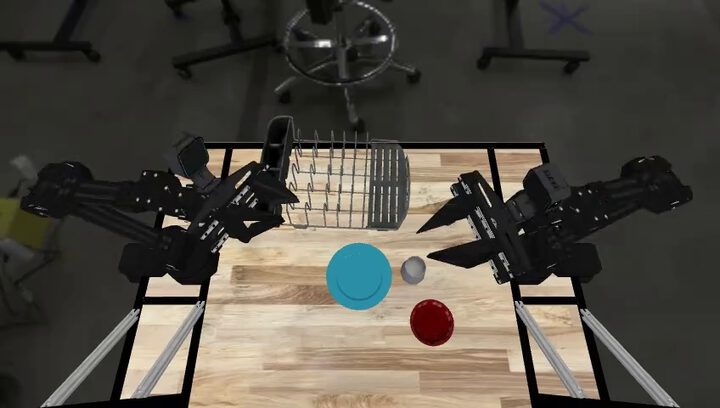
Asks how much robotic manipulation can gain from data-driven, approximate models of physics, and argues that coupling intuition tightly with control unlocks richer manipulation behaviour.

abstract

When we compare object manipulation capabilities in humans and contemporary robots, we observe an intriguing dichotomy: On one hand, robots have access to advanced compute capacity and precise models of physics, yet their object manipulation skills are comparatively narrow and brittle. On the other hand, the human understanding of physics is allegedly acquired from experience and exhibits many predictive shortcomings, yet their manipulation skills far exceed any contemporary robot's. Motivated by this observation, this thesis studies the question how much robotic manipulation can benefit from embracing data-driven, approximate models of physics and poses the hypothesis that a tight integration of intuition and control can unlock sophisticated manipulation behaviour.

In particular, three aspects of physical intuition are investigated: (i) high-level intuitions for visual task assessment and their application in object stacking and tool use, (ii) low-level intuitions for rigid-body motions and their application in rearrangement planning and visuomotor control, (iii) the integration of dynamics approximation into control policy learning and its application in structured exploration of an environment.

In the first part, we demonstrate the effectiveness of a visual stability classifier in planning and constructing stable stacks of objects with varying geometries. We also employ a similar task classification technique in a goal-reaching task and show that the associated variational latent space induces an affordance manifold which can be traversed to synthesise suitable tools for a given task. In the second part, we demonstrate that the introduction of dynamics modelling into an object-centric latent space facilitates object disentanglement from raw visual training data and allows to generate physically plausible scenes and videos from scratch. Visual dynamics approximation is also used in our novel, goal-conditioned, visuomotor control architecture where it enables zero-shot transfer to unseen object rearrangement tasks. Finally, we integrate dynamics forecasting and control policy learning in the third part of this thesis and optimise both components using a curiosity objective. This setup leads to the unsupervised emergence of complex, human interpretable manipulation and locomotion behaviour and highlights the crucial importance of physical intuition in the learning process of sophisticated, embodied behaviour.
VLAs and Agentic Robotics

AREA 01 · 5 PAPERS

  1. arXiv · 2026

    EXIMO: VLM Guided Exploration of VLA Policies

    B. Sukhija, Oliver Groth, M. Shridhar, T. Hertweck, M. Bloesch, M. Wulfmeier, A. Abdolmaleki, M. Riedmiller

    abstract

    How to efficiently finetune robot policies to learn new tasks on the fly? State of the art robotic manipulation policies are based on behaviour cloning of large vision-language-action (VLA) models with billions of parameters on huge teleoperation datasets. While this simple approach has enabled significant advances for robotic manipulation, finetuning of VLA policies for learning new tasks still remains an open problem. In particular, collecting teleoperation datasets requires hundreds of hours of expensive human labour and the alternative, reinforcement learning (RL), can be notoriously sample-inefficient especially for long-horizon tasks. In addition, RL with VLAs imposes several challenges due to the model's size and architectural design. In this work, we propose EXIMO, an efficient algorithm for finetuning of VLA policies. EXIMO operates in three stages: explore, imitate, and optimize. During the explore phase, EXIMO equips the VLA with a vision language model (VLM) that acts as a planner. The VLM thinks and breaks down challenging long-horizon problems into shorter ones for the VLA. The VLM, together with the VLA, is used to collect an orchestrated dataset on new tasks. During the imitate phase, the VLA is finetuned with the orchestrated data. Finally, during the optimize stage, we use residual off-policy RL to further finetune the policy. In our experiments, we ablate all three stages of EXIMO and show that it outperforms existing approaches significantly in terms of sample-efficiency and final performance.

  2. Blog · 2026

    Gemini Robotics 2 brings whole body intelligence to robots

    Gemini Robotics Team, incl. Oliver Groth

    abstract

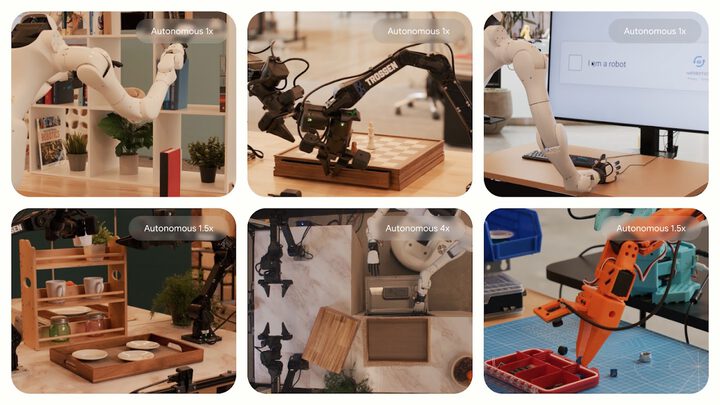
    We demonstrated how Gemini's multimodal understanding could drive real-world action with Gemini Robotics. Today, we are introducing Gemini Robotics 2 - the intelligence layer powering the next generation of truly adaptable robots. As it takes its first literal steps, this major advance unlocks intelligent whole-body control, advanced dexterity, and multi-robot collaboration.

    Gemini Robotics 2 enables robots to reason through every movement, unlocking a broad range of tasks. For example, it can enable a humanoid to walk, crouch, stretch, and manipulate objects to clean up a cluttered room. It can even team up with other robots to finish the job faster. And this profound intelligence can also run locally on-device while seamlessly adapting to entirely new robotic bodies in just a few hours.

  3. arXiv · 2025

    Gemini Robotics 1.5: Pushing the Frontier of Generalist Robots with Advanced Embodied Reasoning, Thinking, and Motion Transfer

    Gemini Robotics Team, incl. Oliver Groth

    abstract

    General-purpose robots need a deep understanding of the physical world, advanced reasoning, and general and dexterous control. This report introduces the latest generation of the Gemini Robotics model family: Gemini Robotics 1.5, a multi-embodiment Vision-Language-Action (VLA) model, and Gemini Robotics-ER 1.5, a state-of-the-art Embodied Reasoning (ER) model. We are bringing together three major innovations. First, Gemini Robotics 1.5 features a novel architecture and a Motion Transfer (MT) mechanism, which enables it to learn from heterogeneous, multi-embodiment robot data and makes the VLA more general. Second, Gemini Robotics 1.5 interleaves actions with a multi-level internal reasoning process in natural language. This enables the robot to "think before acting" and notably improves its ability to decompose and execute complex, multi-step tasks, and also makes the robot's behavior more interpretable to the user. Third, Gemini Robotics-ER 1.5 establishes a new state-of-the-art for embodied reasoning, i.e., for reasoning capabilities that are critical for robots, such as visual and spatial understanding, task planning, and progress estimation. Together, this family of models takes us a step towards an era of physical agents-enabling robots to perceive, think and then act so they can solve complex multi-step tasks.

  4. Blog · 2025

    Gemini Robotics On-Device brings AI to local robotic devices

    Gemini Robotics Team, incl. Oliver Groth

    abstract

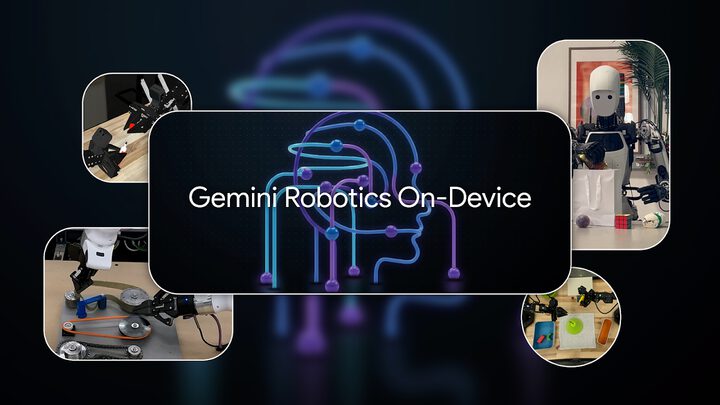
    Today, we’re introducing Gemini Robotics On-Device, our most powerful VLA model optimized to run locally on robotic devices. Gemini Robotics On-Device shows strong general-purpose dexterity and task generalization, and it’s optimized to run efficiently on the robot itself. Since the model operates independent of a data network, it’s helpful for latency sensitive applications, and ensures robustness in environments with intermittent or zero connectivity.

    We’re also sharing a Gemini Robotics SDK to help developers easily evaluate Gemini Robotics On-Device on their tasks and environments, test our model in our MuJoCo physics simulator, and quickly adapt it to new domains, with as few as 50 to 100 demonstrations.

  5. TMLR · 2023

    RoboCat: A Self-Improving Generalist Agent for Robotic Manipulation

    K. Bousmalis, G. Vezzani, D. Rao, …, Oliver Groth, …, R. Hadsell, F. Nori, N. Heess

    abstract

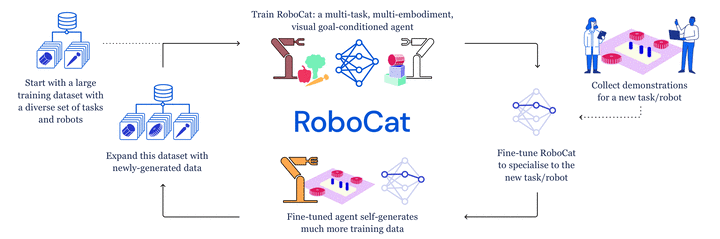
    The ability to leverage heterogeneous robotic experience from different robots and tasks to quickly master novel skills and embodiments has the potential to transform robot learning. Inspired by recent advances in foundation models for vision and language, we propose a multi-embodiment, multi-task generalist agent for robotic manipulation. This agent, named RoboCat, is a visual goal-conditioned decision transformer capable of consuming action-labelled visual experience. This data spans a large repertoire of motor control skills from simulated and real robotic arms with varying sets of observations and actions. With RoboCat, we demonstrate the ability to generalise to new tasks and robots, both zero-shot as well as through adaptation using only 100-1000 examples for the target task. We also show how a trained model itself can be used to generate data for subsequent training iterations, thus providing a basic building block for an autonomous improvement loop. We investigate the agent's capabilities, with large-scale evaluations both in simulation and on three different real robot embodiments. We find that as we grow and diversify its training data, RoboCat not only shows signs of cross-task transfer, but also becomes more efficient at adapting to new tasks.

RL for Continuous Control

AREA 02 · 1 PAPER

  1. Science · 2025

    Improving cosmological reach of a gravitational wave observatory using Deep Loop Shaping

    J. Buchli, B. Tracey, T. Andric, …, Oliver Groth, …, P. Kohli, M. Riedmiller, LIGO Instrument Team

    abstract

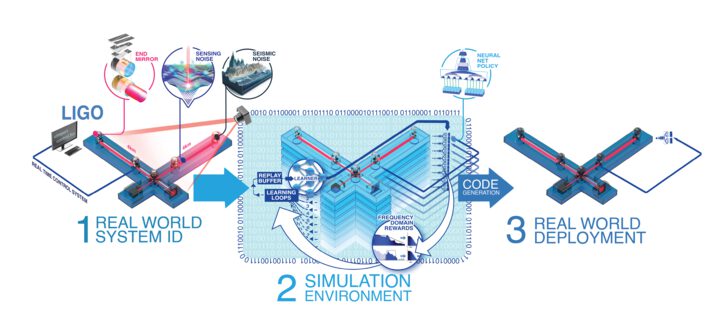
    Improved low-frequency sensitivity of gravitational wave observatories would unlock study of intermediate-mass black hole mergers, binary black hole eccentricity, and provide early warnings for multi-messenger observations of binary neutron star mergers. Today's mirror stabilization control injects harmful noise, constituting a major obstacle to sensitivity improvements. We eliminated this noise through Deep Loop Shaping, a reinforcement learning method using frequency domain rewards. We proved our methodology on the LIGO Livingston Observatory (LLO). Our controller reduced control noise in the 10--30Hz band by over 30x, and up to 100x in sub-bands surpassing the design goal motivated by the quantum limit. These results highlight the potential of Deep Loop Shaping to improve current and future GW observatories, and more broadly instrumentation and control systems.

Large-scale RL

AREA 03 · 3 PAPERS

  1. ICML · 2024

    Offline Actor-Critic Reinforcement Learning Scales to Large Models

    J. T. Springenberg, A. Abdolmaleki, J. Zhang, Oliver Groth, M. Bloesch, T. Lampe, P. Brakel, S. Bechtle, S. Kapturowski, R. Hafner, N. Heess, M. Riedmiller

    abstract

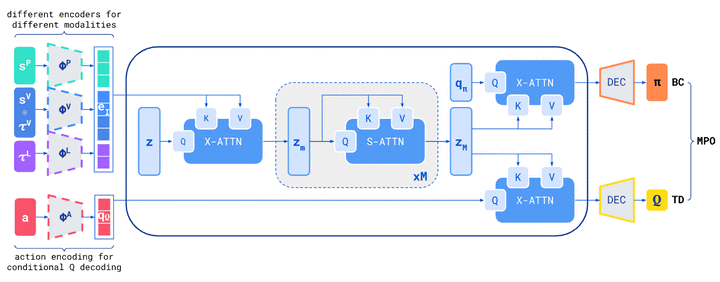
    We show that offline actor-critic reinforcement learning can scale to large models - such as transformers - and follows similar scaling laws as supervised learning. We find that offline actor-critic algorithms can outperform strong, supervised, behavioral cloning baselines for multi-task training on a large dataset containing both sub-optimal and expert behavior on 132 continuous control tasks. We introduce a Perceiver-based actor-critic model and elucidate the key model features needed to make offline RL work with self- and cross-attention modules. Overall, we find that: i) simple offline actor critic algorithms are a natural choice for gradually moving away from the currently predominant paradigm of behavioral cloning, and ii) via offline RL it is possible to learn multi-task policies that master many domains simultaneously, including real robotics tasks, from sub-optimal demonstrations or self-generated data.

  2. ICRA · 2024

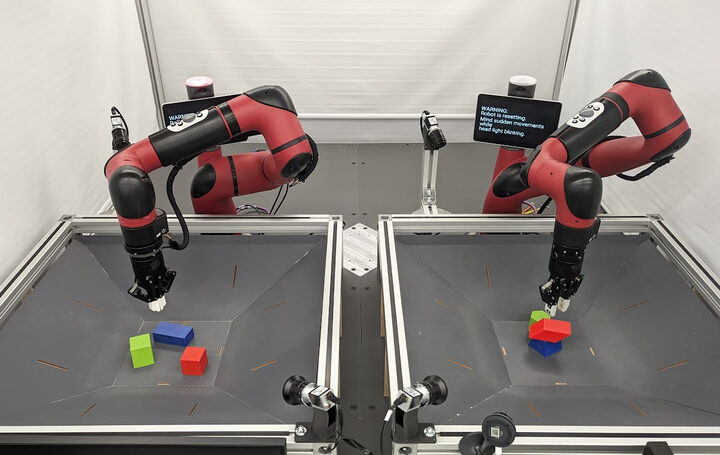
    Mastering Stacking of Diverse Shapes with Large-Scale Iterative Reinforcement Learning on Real Robots

    T. Lampe, A. Abdolmaleki, S. Bechtle, S. H. Huang, J. T. Springenberg, M. Bloesch, Oliver Groth, R. Hafner, T. Hertweck, M. Neunert, M. Wulfmeier, J. Zhang, F. Nori, N. Heess, M. Riedmiller

    abstract

    Reinforcement learning solely from an agent's self-generated data is often believed to be infeasible for learning on real robots, due to the amount of data needed. However, if done right, agents learning from real data can be surprisingly efficient through re-using previously collected sub-optimal data. In this paper we demonstrate how the increased understanding of off-policy learning methods and their embedding in an iterative online/offline scheme (``collect and infer'') can drastically improve data-efficiency by using all the collected experience, which empowers learning from real robot experience only. Moreover, the resulting policy improves significantly over the state of the art on a recently proposed real robot manipulation benchmark. Our approach learns end-to-end, directly from pixels, and does not rely on additional human domain knowledge such as a simulator or demonstrations.

  3. ICLR · 2024

    Unlocking the Power of Representations in Long-term Novelty-based Exploration

    A. Saade, S. Kapturowski, D. Calandriello, C. Blundell, P. Sprechmann, L. Sarra, Oliver Groth, M. Valko, B. Piot

    abstract

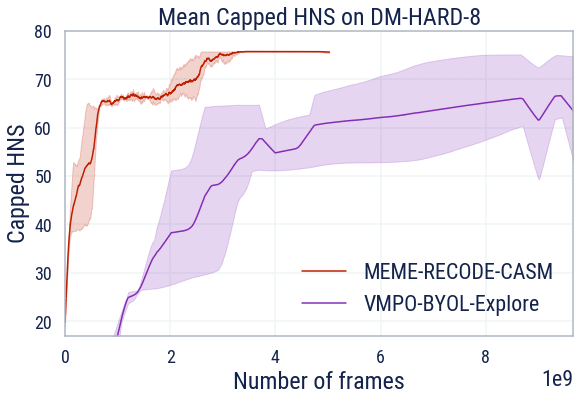
    We introduce Robust Exploration via Clustering-based Online Density Estimation (RECODE), a non-parametric method for novelty-based exploration that estimates visitation counts for clusters of states based on their similarity in a chosen embedding space. By adapting classical clustering to the nonstationary setting of Deep RL, RECODE can efficiently track state visitation counts over thousands of episodes. We further propose a novel generalization of the inverse dynamics loss, which leverages masked transformer architectures for multi-step prediction; which in conjunction with RECODE achieves a new state-of-the-art in a suite of challenging 3D-exploration tasks in DM-Hard-8. RECODE also sets new state-of-the-art in hard exploration Atari games, and is the first agent to reach the end screen in "Pitfall!".

Robots & physical intuition

AREA 04 · 6 PAPERS + THESIS

  1. DPhil thesis · 2021

    Learning Physical Intuition for Robotic Manipulation

    Oliver Groth · University of Oxford

    abstract

    When we compare object manipulation capabilities in humans and contemporary robots, we observe an intriguing dichotomy: On one hand, robots have access to advanced compute capacity and precise models of physics, yet their object manipulation skills are comparatively narrow and brittle. On the other hand, the human understanding of physics is allegedly acquired from experience and exhibits many predictive shortcomings, yet their manipulation skills far exceed any contemporary robot's. Motivated by this observation, this thesis studies the question how much robotic manipulation can benefit from embracing data-driven, approximate models of physics and poses the hypothesis that a tight integration of intuition and control can unlock sophisticated manipulation behaviour.

    In particular, three aspects of physical intuition are investigated: (i) high-level intuitions for visual task assessment and their application in object stacking and tool use, (ii) low-level intuitions for rigid-body motions and their application in rearrangement planning and visuomotor control, (iii) the integration of dynamics approximation into control policy learning and its application in structured exploration of an environment.

    In the first part, we demonstrate the effectiveness of a visual stability classifier in planning and constructing stable stacks of objects with varying geometries. We also employ a similar task classification technique in a goal-reaching task and show that the associated variational latent space induces an affordance manifold which can be traversed to synthesise suitable tools for a given task. In the second part, we demonstrate that the introduction of dynamics modelling into an object-centric latent space facilitates object disentanglement from raw visual training data and allows to generate physically plausible scenes and videos from scratch. Visual dynamics approximation is also used in our novel, goal-conditioned, visuomotor control architecture where it enables zero-shot transfer to unseen object rearrangement tasks. Finally, we integrate dynamics forecasting and control policy learning in the third part of this thesis and optimise both components using a curiosity objective. This setup leads to the unsupervised emergence of complex, human interpretable manipulation and locomotion behaviour and highlights the crucial importance of physical intuition in the learning process of sophisticated, embodied behaviour.
  2. arXiv · 2021

    Is Curiosity All You Need? On the Utility of Emergent Behaviours from Curious Exploration

    Oliver Groth, M. Wulfmeier, G. Vezzani, V. Dasagi, T. Hertweck, R. Hafner, N. Heess, M. Riedmiller

    abstract

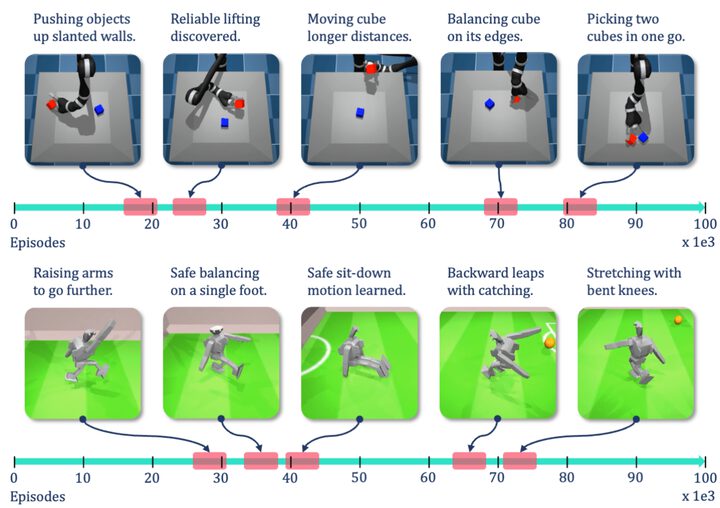
    Curiosity-based reward schemes can present powerful exploration mechanisms which facilitate the discovery of solutions for complex, sparse or long-horizon tasks. However, as the agent learns to reach previously unexplored spaces and the objective adapts to reward new areas, many behaviours emerge only to disappear due to being overwritten by the constantly shifting objective. We argue that merely using curiosity for fast environment exploration or as a bonus reward for a specific task does not harness the full potential of this technique and misses useful skills. Instead, we propose to shift the focus towards retaining the behaviours which emerge during curiosity-based learning. We posit that these self-discovered behaviours serve as valuable skills in an agent's repertoire to solve related tasks. Our experiments demonstrate the continuous shift in behaviour throughout training and the benefits of a simple policy snapshot method to reuse discovered behaviour for transfer tasks.

  3. ICRA · 2021

    Goal-Conditioned End-to-End Visuomotor Control for Versatile Skill Primitives

    Oliver Groth, C.-M. Hung, A. Vedaldi, I. Posner

    abstract

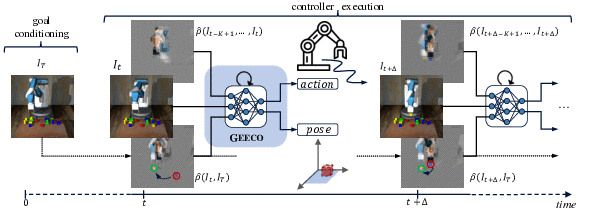
    Visuomotor control (VMC) is an effective means of achieving basic manipulation tasks such as pushing or pick-and-place from raw images. Conditioning VMC on desired goal states is a promising way of achieving versatile skill primitives. However, common conditioning schemes either rely on task-specific fine tuning - e.g. using one-shot imitation learning (IL) - or on sampling approaches using a forward model of scene dynamics i.e. model-predictive control (MPC), leaving deployability and planning horizon severely limited. In this paper we propose a conditioning scheme which avoids these pitfalls by learning the controller and its conditioning in an end-to-end manner. Our model predicts complex action sequences based directly on a dynamic image representation of the robot motion and the distance to a given target observation. In contrast to related works, this enables our approach to efficiently perform complex manipulation tasks from raw image observations without predefined control primitives or test time demonstrations. We report significant improvements in task success over representative MPC and IL baselines. We also demonstrate our model's generalisation capabilities in challenging, unseen tasks featuring visual noise, cluttered scenes and unseen object geometries.

  4. NeurIPS · 2020

    RELATE: Physically Plausible Multi-Object Scene Synthesis Using Structured Latent Spaces

    S. Ehrhardt*, Oliver Groth*, A. Monszpart, M. Engelcke, I. Posner, N. Mitra, A. Vedaldi

    abstract

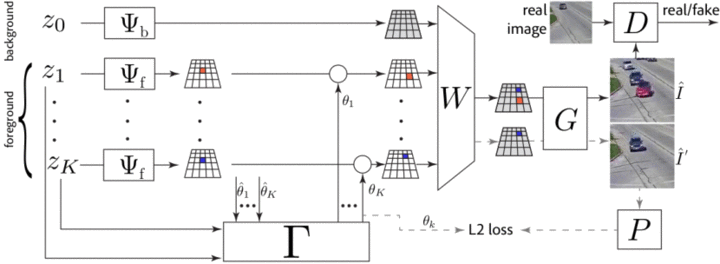
    We present RELATE, a model that learns to generate physically plausible scenes and videos of multiple interacting objects. Similar to other generative approaches, RELATE is trained end-to-end on raw, unlabeled data. RELATE combines an object-centric GAN formulation with a model that explicitly accounts for correlations between individual objects. This allows the model to generate realistic scenes and videos from a physically-interpretable parameterization. Furthermore, we show that modeling the object correlation is necessary to learn to disentangle object positions and identity. We find that RELATE is also amenable to physically realistic scene editing and that it significantly outperforms prior art in object-centric scene generation in both synthetic (CLEVR, ShapeStacks) and real-world data (cars). In addition, in contrast to state-of-the-art methods in object-centric generative modeling, RELATE also extends naturally to dynamic scenes and generates videos of high visual fidelity.

  5. OOL @ ICML · 2020

    Learning Affordances in Object-Centric Generative Models

    Y. Wu*, S. Kasewa*, Oliver Groth*, S. Salter, L. Sun, O. Parker Jones, I. Posner

    Outstanding Paper Award

    abstract

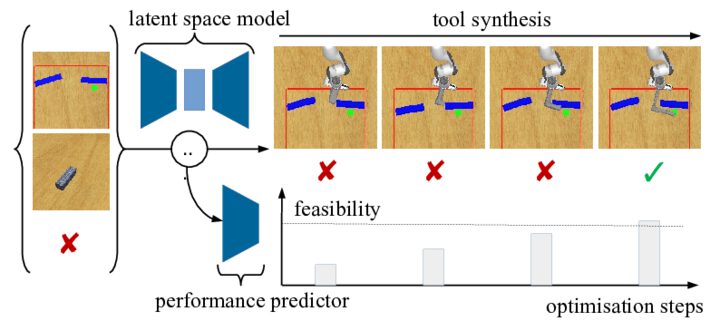
    Given visual observations of a reaching task together with a stick-like tool, we propose a novel approach that learns to exploit task-relevant object affordances by combining generative modelling with a task-based performance predictor. The embedding learned by the generative model captures the factors of variation in object geometry, e.g. length, width, and configuration. The performance predictor identifies sub-manifolds correlated with task success in a weakly supervised manner. Using a 3D simulation environment, we demonstrate that traversing the latent space in this task-driven way results in appropriate tool geometries for the task at hand. Our results suggest that affordances are encoded along smooth trajectories in the learned latent space. Given only high-level performance criteria (such as task success), accessing these emergent affordances via gradient descent enables the agent to manipulate learned object geometries in a targeted and deliberate way.

  6. BMVC · 2019

    Scrutinizing and De-Biasing Intuitive Physics with Neural Stethoscopes

    F. B. Fuchs, Oliver Groth, A. R. Kosiorek, A. Bewley, M. Wulfmeier, A. Vedaldi, I. Posner

    abstract

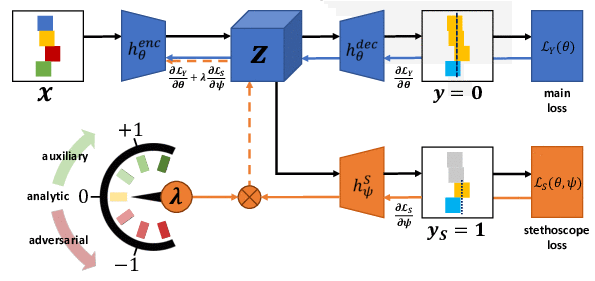
    Visually predicting the stability of block towers is a popular task in the domain of intuitive physics. While previous work focusses on prediction accuracy, a one-dimensional performance measure, we provide a broader analysis of the learned physical understanding of the final model and how the learning process can be guided. To this end, we introduce neural stethoscopes as a general purpose framework for quantifying the degree of importance of specific factors of influence in deep neural networks as well as for actively promoting and suppressing information as appropriate. In doing so, we unify concepts from multitask learning as well as training with auxiliary and adversarial losses. We apply neural stethoscopes to analyse the state-of-the-art neural network for stability prediction. We show that the baseline model is susceptible to being misled by incorrect visual cues. This leads to a performance breakdown to the level of random guessing when training on scenarios where visual cues are inversely correlated with stability. Using stethoscopes to promote meaningful feature extraction increases performance from 51% to 90% prediction accuracy. Conversely, training on an easy dataset where visual cues are positively correlated with stability, the baseline model learns a bias leading to poor performance on a harder dataset. Using an adversarial stethoscope, the network is successfully de-biased, leading to a performance increase from 66% to 88%.

  7. ECCV · 2018

    ShapeStacks: Learning Vision-Based Physical Intuition for Generalised Object Stacking

    Oliver Groth, F. B. Fuchs, I. Posner, A. Vedaldi

    abstract

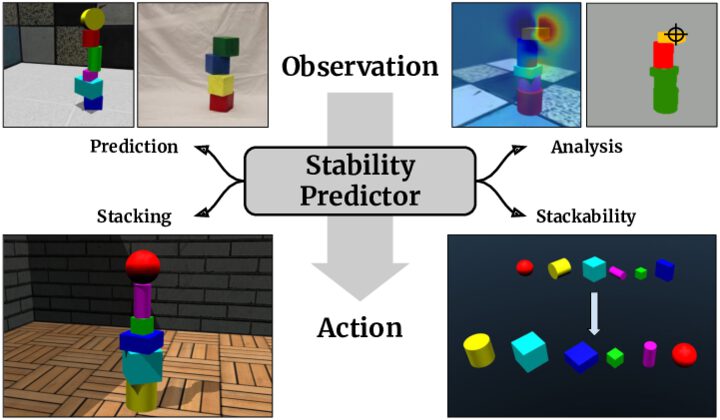
    Physical intuition is pivotal for intelligent agents to perform complex tasks. In this paper we investigate the passive acquisition of an intuitive understanding of physical principles as well as the active utilisation of this intuition in the context of generalised object stacking. To this end, we provide ShapeStacks: a simulation-based dataset featuring 20,000 stack configurations composed of a variety of elementary geometric primitives richly annotated regarding semantics and structural stability. We train visual classifiers for binary stability prediction on the ShapeStacks data and scrutinise their learned physical intuition. Due to the richness of the training data our approach also generalises favourably to real-world scenarios achieving state-of-the-art stability prediction on a publicly available benchmark of block towers. We then leverage the physical intuition learned by our model to actively construct stable stacks and observe the emergence of an intuitive notion of stackability-an inherent object affordance-induced by the active stacking task. Our approach performs well exceeding the stack height observed during training and even manages to counterbalance initially unstable structures.

Image captioning

AREA 05 · 2 PAPERS

  1. IJCV · 2017

    Visual Genome: Connecting Language and Vision Using Crowdsourced Dense Image Annotations

    R. Krishna, Y. Zhu, Oliver Groth, J. Johnson, K. Hata, J. Kravitz, S. Chen, Y. Kalantidis, L.-J. Li, D. A. Shamma, M. S. Bernstein, L. Fei-Fei

    abstract

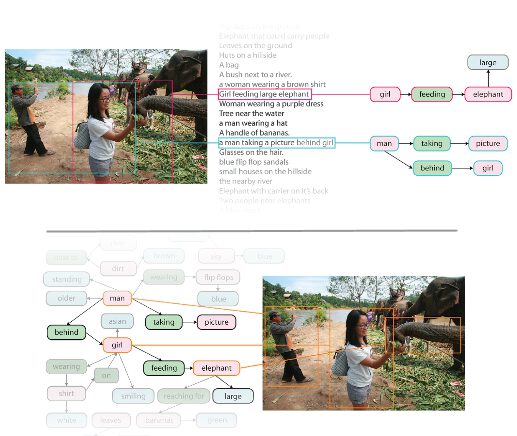
    Despite progress in perceptual tasks such as image classification, computers still perform poorly on cognitive tasks such as image description and question answering. Cognition is core to tasks that involve not just recognizing, but reasoning about our visual world. However, models used to tackle the rich content in images for cognitive tasks are still being trained using the same datasets designed for perceptual tasks. To achieve success at cognitive tasks, models need to understand the interactions and relationships between objects in an image. When asked “What vehicle is the person riding?”, computers will need to identify the objects in an image as well as the relationships riding(man, carriage) and pulling(horse, carriage) to answer correctly that “the person is riding a horse-drawn carriage.” In this paper, we present the Visual Genome dataset to enable the modeling of such relationships. We collect dense annotations of objects, attributes, and relationships within each image to learn these models. Specifically, our dataset contains over 108K images where each image has an average of 35 objects, 26 attributes, and 21 pairwise relationships between objects. We canonicalize the objects, attributes, relationships, and noun phrases in region descriptions and questions answer pairs to WordNet synsets. Together, these annotations represent the densest and largest dataset of image descriptions, objects, attributes, relationships, and question answer pairs.

  2. CVPR · 2016

    Visual7W: Grounded Question Answering in Images

    Y. Zhu, Oliver Groth, M. Bernstein, L. Fei-Fei

    abstract

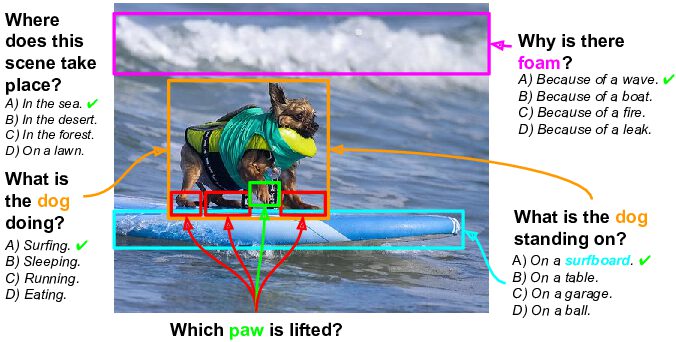
    We have seen great progress in basic perceptual tasks such as object recognition and detection. However, AI models still fail to match humans in high-level vision tasks due to the lack of capacities for deeper reasoning. Recently the new task of visual question answering (QA) has been proposed to evaluate a model's capacity for deep image understanding. Previous works have established a loose, global association between QA sentences and images. However, many questions and answers, in practice, relate to local regions in the images. We establish a semantic link between textual descriptions and image regions by object-level grounding. It enables a new type of QA with visual answers, in addition to textual answers used in previous work. We study the visual QA tasks in a grounded setting with a large collection of 7W multiple-choice QA pairs. Furthermore, we evaluate human performance and several baseline models on the QA tasks. Finally, we propose a novel LSTM model with spatial attention to tackle the 7W QA tasks.

Misc

AREA 06 · 2 PAPERS

  1. IROS · 2025

    Exploiting Policy Idling for Dexterous Manipulation

    A. S. Chen, P. Brakel, A. Bronars, A. Xie, S. Huang, Oliver Groth, M. Bauza, M. Wulfmeier, N. Heess, D. Rao

    abstract

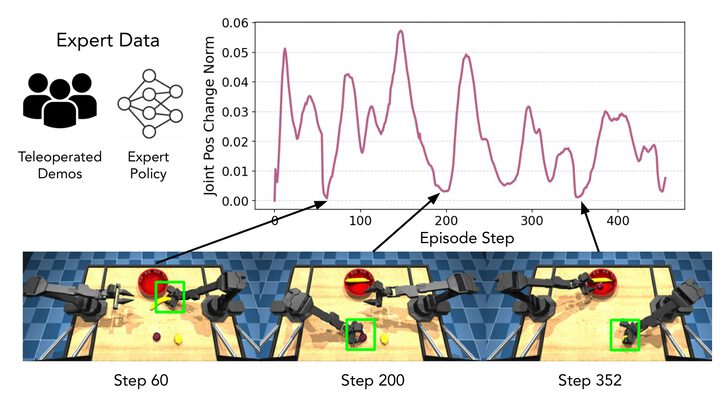
    Learning-based methods for dexterous manipulation have made notable progress in recent years. However, learned policies often still lack reliability and exhibit limited robustness to important factors of variation. One failure pattern that can be observed across many settings is that policies idle, i.e. they cease to move beyond a small region of states when they reach certain states. This policy idling is often a reflection of the training data. For instance, it can occur when the data contains small actions in areas where the robot needs to perform high-precision motions, e.g., when preparing to grasp an object or object insertion. Prior works have tried to mitigate this phenomenon e.g. by filtering the training data or modifying the control frequency. However, these approaches can negatively impact policy performance in other ways. As an alternative, we investigate how to leverage the detectability of idling behavior to inform exploration and policy improvement. Our approach, Pause-Induced Perturbations (PIP), applies perturbations at detected idling states, thus helping it to escape problematic basins of attraction. On a range of challenging simulated dual-arm tasks, we find that this simple approach can already noticeably improve test-time performance, with no additional supervision or training. Furthermore, since the robot tends to idle at critical points in a movement, we also find that learning from the resulting episodes leads to better iterative policy improvement compared to prior approaches. Our perturbation strategy also leads to a 15-35% improvement in absolute success rate on a real-world insertion task that requires complex multi-finger manipulation.

  2. ICRA · 2017

    Analyzing Modular CNN Architectures for Joint Depth Prediction and Semantic Segmentation

    O. Hosseini Jafari, Oliver Groth, A. Kirillov, M. Y. Yang, C. Rother

    abstract

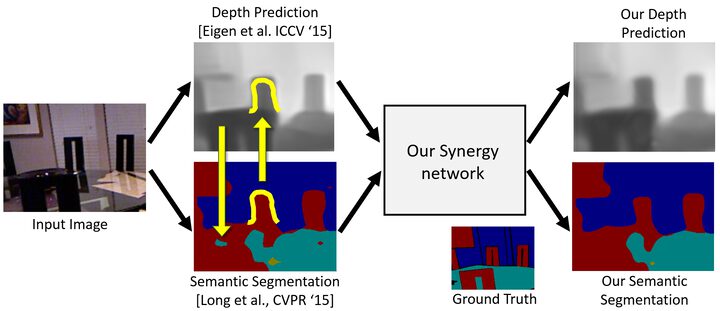
    This paper addresses the task of designing a modular neural network architecture that jointly solves different tasks. As an example we use the tasks of depth estimation and semantic segmentation given a single RGB image. The main focus of this work is to analyze and achieve the so-called synergy effect between the different tasks. While most previous works solely focus on measuring improvements in accuracy, we are the first to quantify the synergy effect. We show that there is a relationship between accuracy and the synergy effect, although not a simple linear one. Hence a larger synergy effect does not necessarily mean an improved accuracy. This relationship can be utilized to understand different design choices in network architectures. Towards this end we propose a shallow Convolutional Neural Network (CNN) architecture that fuses the state of the state-of-the-art results for depth estimation and semantic labeling. By doing so we achieve improved results for both tasks using the NYU-Depth v2 benchmark.